
Spousal support, often called alimony, is financial support that one spouse may be required to provide to the other after or during a divorce. One of the most common questions people have about alimony is: How long does spousal support last?
There is no universal answer. The duration of spousal support depends on several factors, including the laws of the state, the length of the marriage, each spouse’s financial circumstances, the type of support awarded, and the terms of the divorce order or settlement agreement.
Some support awards last for only a limited period, while others may continue for many years. In certain circumstances, support can continue indefinitely until a specific event occurs.
Understanding how courts determine the duration of spousal support can help divorcing spouses prepare for the financial consequences of divorce.
What Is Spousal Support?
Spousal support is a payment made by one spouse to another to provide financial assistance during or after a divorce or legal separation.
Different states use different terminology, including:
- Alimony
- Spousal maintenance
- Maintenance
- Spousal support
The purpose of support can also differ depending on the type of award. It may help a lower-earning spouse meet living expenses, transition to financial independence, or maintain a reasonable standard of living after a long marriage.
Spousal support is separate from child support. Child support is intended to help meet a child’s financial needs, while spousal support concerns the financial relationship between former spouses.
Is Spousal Support Always Permanent?
No.
Many people assume that alimony automatically continues until the recipient remarries or dies. While those events can end certain types of support, many modern spousal-support awards are temporary or limited in duration.
A court may establish an end date when the support order is issued.
For example, a court might award support for a specific number of years to give a lower-earning spouse time to obtain education, find employment, or become financially independent.
The exact rules vary significantly between states.
Types of Spousal Support
Understanding the type of support involved is important because different types can have different durations.
Temporary Spousal Support
Temporary support may be awarded while a divorce case is still pending.
Its purpose is generally to help a spouse meet reasonable financial needs during the divorce process.
Temporary support usually ends when the divorce is finalized, although the final divorce order may establish a different support arrangement.
Rehabilitative Support
Rehabilitative support is generally intended to help a spouse become financially self-sufficient.
For example, a spouse who stayed out of the workforce to care for children may need time to obtain education, training, or employment.
The court may order support for a specific period.
Reimbursement Support
In some circumstances, support may be related to contributions one spouse made toward the other’s education or career.
The availability and treatment of this type of support depend on state law.
Permanent or Long-Term Support
Some jurisdictions allow long-term or indefinite support in appropriate circumstances.
This does not necessarily mean payments will continue forever. The order may provide that support continues until a specified event occurs, such as the death of either spouse or remarriage of the recipient.
State law determines whether this type of support is available and under what circumstances.
Does the Length of the Marriage Matter?
Yes, the length of the marriage can be an important factor.
Courts often distinguish between short-term, moderate-length, and long-term marriages when determining whether support should be awarded and how long it should continue.
A short marriage may result in limited or temporary support, particularly when both spouses are financially independent.
A long marriage may result in longer-lasting support, especially when there is a substantial difference in income and earning ability.
However, there is no universal rule that says a certain number of years of marriage automatically creates a specific number of years of alimony.
Each state’s law is different.
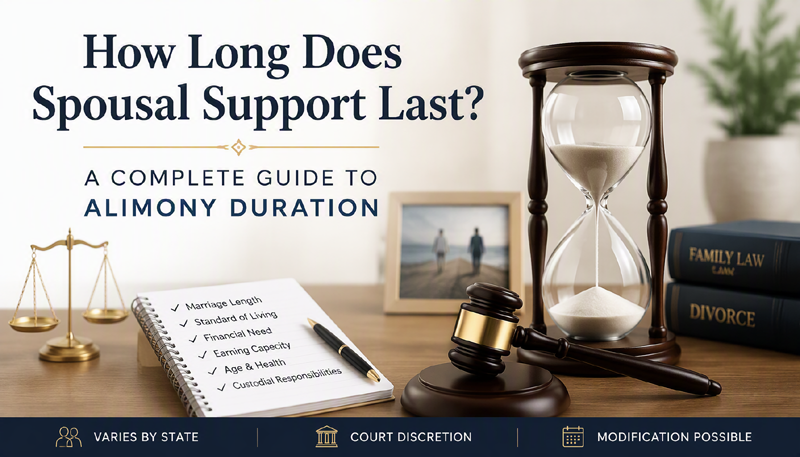
What Factors Determine How Long Spousal Support Lasts?
Courts may consider numerous factors when determining the duration of support.
These can include:
Length of the Marriage
Longer marriages may support longer periods of financial assistance.
Each Spouse’s Income
The court may compare the income and earning capacity of both spouses.
Financial Needs
The recipient’s reasonable financial needs can be important when determining the appropriate amount and duration.
Ability to Pay
The spouse who is expected to pay support must generally have the financial ability to do so.
Age of the Spouses
Age may affect employment prospects, retirement planning, and the ability to become financially independent.
Education and Employment History
A spouse who has been out of the workforce for many years may need additional time to return to employment.
Contributions During the Marriage
Courts may consider contributions made by each spouse, including homemaking and childcare.
Health and Disability
Health-related limitations may affect a spouse’s ability to work and become self-supporting.
Standard of Living
In some states, the standard of living established during the marriage can be considered when determining support.
The precise factors depend on applicable state law.
Does Alimony End When You Remarry?
In many jurisdictions, remarriage of the recipient can affect or terminate spousal support.
However, the rules are not identical everywhere.
Some support orders automatically terminate upon remarriage, while others may require a court proceeding or contain specific language addressing the issue.
If a recipient begins living with a new partner, that can also have consequences in some states, but cohabitation is not automatically treated the same as remarriage everywhere.
Anyone dealing with remarriage or cohabitation should review the support order and applicable state law before assuming payments should stop.
Does Spousal Support End When Someone Dies?
Many forms of spousal support terminate upon the death of either spouse.
However, exceptions can exist, particularly when the parties have created a contractual arrangement that provides otherwise.
Life insurance may also be used in some divorce agreements to secure support obligations.
The exact terms should be reviewed carefully because the consequences can be significant for both spouses and their families.
Can Spousal Support Be Modified?
Sometimes.
Whether support can be modified depends on the type of support, the wording of the order or agreement, and state law.
A substantial change in circumstances may potentially justify modification in some situations.
Examples might include:
- Significant changes in income
- Job loss
- Retirement
- Serious illness
- Disability
- Major changes in financial needs
- Other circumstances recognized under state law
However, not every support order is modifiable.
Some divorce agreements specifically state that support is non-modifiable. If an agreement is incorporated into a court order, the exact language can be extremely important.
What Happens When the Paying Spouse Retires?
Retirement can create complicated spousal-support issues.
A person who has been paying alimony may eventually reach retirement age and experience a substantial reduction in income.
Some states have laws addressing whether retirement can justify modifying or ending support.
Courts may consider factors such as the person’s age, expected retirement date, financial circumstances, whether retirement is reasonable, and the recipient’s continuing needs.
Because retirement rules vary, a person should not simply stop making payments without determining whether the law or court order allows it.
Can Spousal Support Last Until Retirement?
It can in some circumstances, but it depends on the applicable law and the terms of the order.
For example, a court could establish support that continues until a particular date or event, potentially including retirement.
In other cases, support may be calculated for a fixed number of years.
The parties may also negotiate an agreement that establishes a specific duration, subject to applicable law and court approval where required.
Can Spouses Agree on How Long Support Will Last?
Often, spouses can negotiate the terms of spousal support as part of a divorce settlement.
An agreement may address:
- Monthly payment amount
- Start date
- End date
- Modification rights
- Termination events
- Security for the obligation
- Tax considerations
- Other financial terms
A negotiated agreement can provide greater predictability than leaving every issue to a judge.
However, spouses should understand the legal consequences before signing. An agreement may contain provisions that are difficult or impossible to change later.
What If the Recipient Becomes Self-Supporting?
If the recipient’s financial circumstances improve, support may potentially be reduced or terminated depending on state law and the terms of the order.
For example, a person may obtain a significantly higher-paying job or otherwise become financially independent.
However, support does not necessarily stop automatically because the recipient starts working.
Whether income changes the support obligation depends on the applicable legal standard and the terms of the existing order.
A paying spouse should not unilaterally reduce payments without determining whether a modification is legally permitted.
What Happens If Spousal Support Is Not Paid?
A valid support order generally creates a legal obligation.
If a paying spouse fails to make required payments, the recipient may have legal remedies available.
Depending on state law, enforcement measures can include:
- Wage withholding
- Collection procedures
- Court enforcement
- Interest or penalties
- Other remedies authorized by law
The specific procedures vary by jurisdiction.
If payments have become unaffordable, the paying spouse should generally seek a lawful modification rather than simply stop paying.
How Can You Estimate How Long Alimony Will Last?
There is no reliable nationwide formula for predicting the exact duration of spousal support.
To estimate the likely duration, consider:
- The state where the divorce will occur
- The length of the marriage
- The age and health of both spouses
- The income and earning capacity of each spouse
- The recipient’s financial needs
- Whether children require significant care
- Whether the recipient can become self-supporting
- The type of support being considered
- Whether the spouses can reach an agreement
- Whether the support order is modifiable
A family-law attorney can review the specific circumstances and explain the applicable rules.
Practical Tips for Both Spouses
Whether you are paying or receiving support, keep accurate financial records.
Important documents may include:
- Tax returns
- Pay stubs
- Bank statements
- Retirement account statements
- Employment records
- Monthly budgets
- Housing expenses
- Insurance costs
- Existing court orders
- Divorce settlement agreements
Clear documentation can make it easier to determine whether the current support arrangement remains appropriate.
Final Thoughts
So, how long does spousal support last? There is no single answer that applies to every divorce.
Support may last for a few months, several years, or, in some cases, an indefinite period subject to specific termination events. The duration can depend on the length of the marriage, financial circumstances, earning capacity, age, health, state law, and the terms of the support order or settlement agreement.
Spousal support can also change when circumstances change, although modification is not available in every case.
If you are negotiating or contesting alimony, carefully review the proposed terms before agreeing to them. Pay particular attention to the amount, duration, termination conditions, and whether the obligation can be modified.
Because alimony laws vary substantially between states, this article provides general information rather than legal advice. Anyone dealing with a significant spousal-support dispute should consider consulting a qualified family-law attorney in the state where the case is being handled.
This article is for general informational purposes only and does not constitute legal advice. State laws and individual divorce orders can produce different results.