
Divorce is often resolved through negotiation, mediation, or a settlement agreement. However, when spouses cannot agree on important issues, the case may proceed to a divorce trial. A divorce trial is a formal court proceeding where both spouses have an opportunity to present evidence, call witnesses, and explain their positions before a judge. The judge then makes decisions about the unresolved issues based on the evidence and applicable state law.
Understanding what happens during a divorce trial can make the process less intimidating. Although divorce laws and procedures vary from state to state, most trials follow a similar general structure.
What Is a Divorce Trial?
A divorce trial occurs when spouses are unable to settle one or more significant issues in their divorce. The trial is generally conducted before a judge rather than a jury.
The judge may be asked to decide matters such as:
- Division of marital property and debts
- Spousal support or alimony
- Child custody and parenting arrangements
- Child support
- Responsibility for certain financial obligations
- Other disputed issues involving the marriage
A trial does not necessarily mean that every issue in the divorce is disputed. In some cases, spouses agree on most matters but need the judge to resolve one or two remaining disagreements.
Before a case reaches trial, the court may require the parties to participate in mediation, settlement conferences, discovery, or other pretrial procedures.

Preparing for a Divorce Trial
Preparation usually begins well before the actual trial date. Both spouses and their attorneys may spend considerable time gathering documents, identifying witnesses, reviewing financial information, and preparing legal arguments.
Common documents may include bank statements, tax returns, pay records, mortgage documents, investment records, business records, insurance information, and evidence concerning marital property.
If children are involved, evidence may also relate to parenting schedules, school records, childcare arrangements, communication between the parents, and the child’s needs.
During preparation, each side may use a legal process called discovery to obtain information from the other spouse. Discovery can involve written questions, requests for documents, and depositions.
The purpose is generally to ensure that each side has access to relevant information before trial.
The Beginning of the Trial
On the trial date, the parties, their attorneys, and witnesses appear in court. The judge presides over the proceedings and determines how the trial will be conducted.
The judge may first address preliminary matters, including which issues remain disputed and which evidence or witnesses will be presented.
The person who filed the divorce case is commonly referred to as the petitioner or plaintiff, depending on the state’s terminology. The other spouse may be called the respondent or defendant.
The terminology and procedures can vary by state.
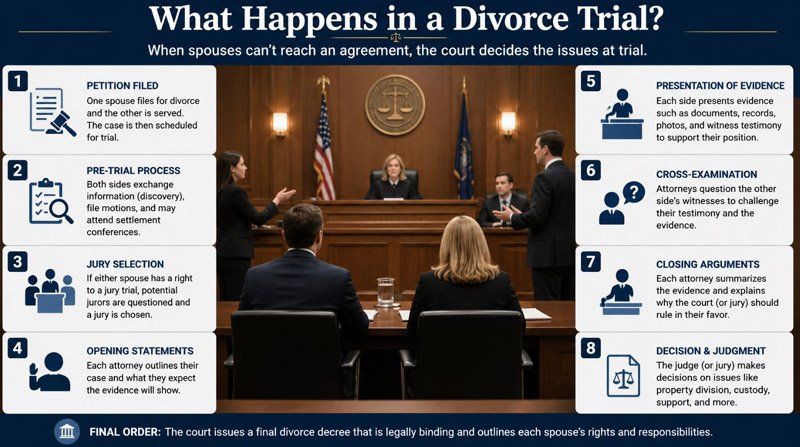
Opening Statements
In many divorce trials, each attorney has an opportunity to make an opening statement.
An opening statement is not evidence. Instead, it gives the judge an overview of what each side expects the evidence to show.
For example, one spouse’s attorney might explain why the client believes a particular property should be awarded to them or why a specific parenting arrangement would be appropriate.
The other attorney then presents their position.
Opening statements are generally intended to provide a roadmap for the trial rather than serve as an opportunity to argue every detail.
Presenting Evidence
After opening statements, the parties begin presenting evidence.
Evidence can include documents, photographs, financial records, electronic communications, expert testimony, and testimony from the spouses or other witnesses.
The rules of evidence determine whether particular information can be presented to the judge. Not everything a person believes is relevant will necessarily be admissible in court.
For this reason, preparation is important. A spouse should work with their attorney to identify the evidence that supports their legal position and understand potential weaknesses in their case.
Testimony From the Spouses
In many divorce trials, both spouses testify.
A spouse may be questioned about finances, property, employment, the history of the marriage, parenting responsibilities, or other disputed matters.
The attorney representing the spouse generally begins with direct examination. The opposing attorney may then conduct cross-examination.
During cross-examination, the attorney may challenge the witness’s statements, question inconsistencies, or ask about evidence that conflicts with the witness’s testimony.
The judge may also ask questions for clarification.
Because statements made under oath can affect the outcome of a case, parties should answer questions truthfully and carefully. Attempting to hide assets, provide false information, or misrepresent important facts can seriously damage a person’s credibility and potentially create additional legal problems.
Witnesses in a Divorce Trial
Spouses are not always the only people who testify. Depending on the issues involved, witnesses may include relatives, teachers, childcare providers, financial professionals, mental health professionals, business associates, or other individuals with relevant information.
For example, if child custody is disputed, a witness might provide information about a parent’s involvement in the child’s daily life.
Financial disputes may require testimony from accountants, business valuation professionals, or other financial experts.
Expert witnesses can be particularly important in complicated cases involving businesses, substantial assets, or specialized financial issues.
Property and Financial Issues
One of the most complicated parts of a divorce trial can be dividing property and debts.
The court generally needs to determine which assets and debts are marital and which may be separate, depending on the law of the state.
Marital property can potentially include:
- Real estate
- Bank accounts
- Retirement accounts
- Investments
- Vehicles
- Businesses
- Personal property
- Certain financial interests acquired during the marriage
Determining the value and ownership of assets can become complicated when spouses disagree about what an asset is worth or whether it should be considered marital property.
A spouse may also need to provide evidence concerning debts and financial contributions.
Financial records are therefore often an important part of a divorce trial.
Child Custody and Parenting Issues
When children are involved, the court’s focus is generally on the child’s best interests under the applicable state law.
A judge may consider factors such as the child’s relationship with each parent, each parent’s ability to provide care, the child’s educational and emotional needs, and the practical feasibility of proposed parenting arrangements.
Depending on the circumstances and state law, the court may make decisions about legal custody, physical custody, parenting time, transportation, holidays, education, healthcare, and other parenting responsibilities.
Courts generally expect parents to focus on the child’s needs rather than using the trial primarily to criticize the other parent.
Child Support and Spousal Support
A divorce trial may also address financial support.
Child support is typically determined using state-specific laws and guidelines. The calculation may consider factors such as parental income, parenting time, health insurance, childcare costs, and the number of children.
Spousal support, sometimes called alimony or maintenance, is handled differently depending on the state. The court may consider factors such as the length of the marriage, each spouse’s financial circumstances, earning capacity, contributions to the marriage, and other statutory factors.
Because support laws differ significantly among states, the applicable rules in the state where the divorce is filed are important.
Closing Arguments
After both sides have presented their evidence and questioned their witnesses, the attorneys may give closing arguments.
Closing arguments allow each side to explain how the evidence supports their requested outcome.
An attorney may summarize important testimony, identify evidence supporting the client’s position, and explain how the applicable law should be applied.
The opposing attorney then presents their argument.
Unlike opening statements, closing arguments occur after the evidence has been presented, allowing attorneys to connect the evidence to the legal issues the judge must decide.
What Does the Judge Decide?
After hearing the evidence and arguments, the judge determines the disputed issues.
The judge may make decisions regarding property division, child custody, parenting time, child support, spousal support, and other matters depending on the case.
In some situations, the judge announces the decision immediately after the trial. In other cases, the judge may take the matter under advisement and issue a written decision later.
The timing depends on the court, the complexity of the case, and local procedures.
The Final Divorce Judgment
The divorce is not necessarily complete simply because the trial has ended.
The court must enter a final judgment or decree formally ending the marriage and resolving the issues before it.
The final order may include provisions concerning property, debts, custody, parenting time, child support, and spousal support.
Once entered, the order generally becomes legally enforceable.
Both spouses should carefully review the final order and understand their responsibilities. Failing to comply with a court order can result in legal consequences.
Can You Appeal a Divorce Trial Decision?
In some circumstances, a party may have the right to appeal a trial court’s decision.
An appeal is not normally a second opportunity to present the entire case simply because one spouse disagrees with the judge’s decision. Appellate courts generally review the trial court for specific legal or procedural errors under the applicable appellate rules.
Appeals can involve strict deadlines and complicated procedures. Anyone considering an appeal should promptly discuss the issue with an attorney familiar with appellate law in the relevant state.
How Long Does a Divorce Trial Take?
There is no single answer. Some divorce trials may last only a few hours, while highly contested cases can take several days or longer.
The length depends on factors such as:
- Number of disputed issues
- Number of witnesses
- Amount of financial evidence
- Complexity of the marital assets
- Child custody disputes
- Expert testimony
- Court scheduling
- Whether either party raises additional legal issues
A complicated divorce involving businesses, substantial assets, or contested custody can require significantly more preparation and courtroom time than an uncomplicated case.
How Can You Prepare?
If your divorce is going to trial, organization can make a major difference.
Keep important financial and legal documents organized. Review information provided by your attorney and make sure they have accurate information about your finances, property, debts, and family circumstances.
You should also understand the issues that remain disputed and the outcome you are asking the court to reach.
If you are required to testify, listen carefully to each question and answer honestly. Avoid arguing with the opposing attorney or speaking over anyone in the courtroom.
Most importantly, follow your attorney’s advice regarding evidence, witnesses, courtroom procedure, and settlement opportunities.
Final Thoughts
A divorce trial is a formal legal process in which a judge hears evidence and decides issues that the spouses could not resolve themselves. It can involve testimony, financial documents, witnesses, expert evidence, cross-examination, and legal arguments.
Although going to trial can be stressful, understanding the process can help you prepare and set realistic expectations. Many divorce cases settle before reaching trial, but when settlement is not possible, the trial provides a structured process for resolving the remaining disputes.
Because divorce law varies considerably from one state to another, anyone facing a contested divorce should consider speaking with a qualified family-law attorney in the appropriate jurisdiction. Legal advice can help you understand your rights, responsibilities, deadlines, and the specific procedures that apply to your case.
This article provides general legal information and is not legal advice. Divorce laws and court procedures vary by state and individual circumstances.