A motorcycle accident can turn your life upside down in a matter of seconds. Along with physical injuries, you may face medical bills, lost income, motorcycle damage, insurance disputes, and emotional stress. When another person’s negligence caused the crash, you may have the right to pursue compensation for your losses.
Hiring a motorcycle accident lawyer can make the legal process easier, but choosing the right attorney matters. Not every personal injury lawyer has the same experience with motorcycle crashes, insurance companies, or the unique challenges injured riders face.
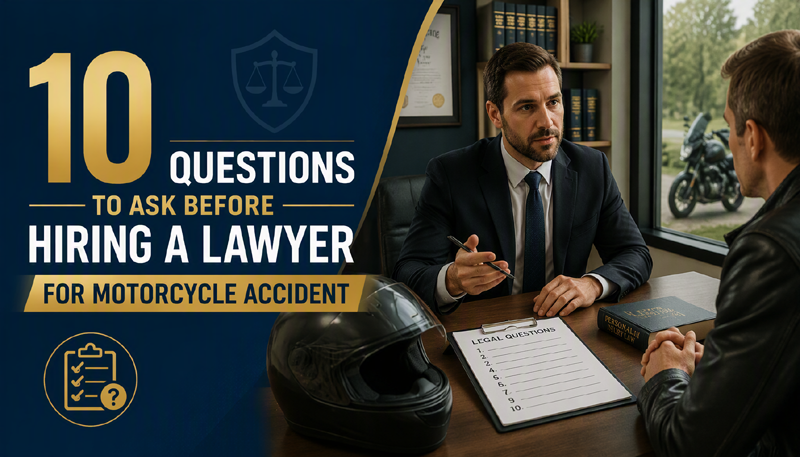
Before hiring an attorney, asking the right questions can help you understand their experience, legal strategy, communication style, and fees. Here are 10 important questions to ask before choosing a motorcycle accident lawyer.
1. How Much Experience Do You Have With Motorcycle Accident Cases?
One of the first questions you should ask is how much experience the lawyer has specifically handling motorcycle accident cases.
Personal injury law covers many different types of claims, including car accidents, truck accidents, slip-and-fall cases, workplace injuries, and medical malpractice. A lawyer may have extensive personal injury experience but limited knowledge of motorcycle collisions.
Motorcycle accidents can present unique legal and factual issues. Riders may face particular challenges involving visibility, road conditions, helmet use, vehicle defects, lane positioning, and allegations that the motorcyclist was responsible for the crash.
Ask the attorney:
“How many motorcycle accident cases have you handled, and how recently?”
You can also ask about the outcomes of cases similar to yours. While past results cannot guarantee what will happen in your case, experience with comparable claims can be valuable.
An attorney who regularly handles motorcycle accident cases is more likely to recognize common defenses and understand what evidence may be important.
2. Do You Have Experience Handling Cases Like Mine?
Every motorcycle accident is different. A collision involving a distracted driver may require a different strategy from one involving a defective motorcycle part, dangerous road conditions, or a commercial vehicle.
Explain the basic circumstances of your accident and ask whether the lawyer has handled similar cases.
For example, your accident might involve:
- A driver who was texting or otherwise distracted
- A driver who failed to yield
- A vehicle making an unsafe left turn
- A hit-and-run driver
- Poorly maintained roads
- A defective motorcycle component
- A commercial truck or delivery vehicle
- A dispute over who caused the collision
Ask:
“Have you handled cases involving these specific circumstances?”
Experience that closely matches your situation may help the lawyer identify evidence and legal issues that a general practitioner could overlook.
3. Who Will Actually Handle My Case?
During your initial consultation, you may meet a senior attorney, but that does not necessarily mean that attorney will personally manage your case.
Some law firms have teams consisting of partners, associates, paralegals, investigators, and administrative staff. There is nothing inherently wrong with this arrangement, but you should know who will be responsible for important decisions.
Ask:
“Will you personally handle my case, or will another attorney or staff member manage it?”
Also ask who you should contact when you have questions.
Knowing your point of contact from the beginning can prevent frustration later. You should understand whether you will communicate directly with the lawyer, a case manager, or a paralegal.
A good law firm should be able to explain its team structure clearly.
4. What Evidence Should We Collect?
Evidence can be extremely important in a motorcycle accident claim. The sooner relevant evidence is preserved, the better.
Ask your lawyer what evidence may be useful in your case.
Depending on the circumstances, evidence may include photographs of the accident scene, motorcycle damage, vehicle damage, injuries, road conditions, traffic signals, and relevant surroundings. Police reports, witness statements, medical records, surveillance video, vehicle data, and other documentation may also be important.
Your attorney may recommend taking steps to preserve evidence before it disappears or is destroyed.
For example, businesses may routinely overwrite surveillance footage. Vehicles may be repaired or sold. Road conditions may change. Witnesses may forget details over time.
Ask:
“What should I do right now to preserve evidence?”
An experienced attorney should give you practical instructions about documentation and explain what they or their team will do to investigate the accident.
5. How Will You Determine Who Was Responsible?
Determining liability is not always as simple as identifying the person who received a traffic citation.
Insurance companies may dispute fault or argue that the motorcycle rider contributed to the accident. Depending on state law, a person’s degree of fault may affect how much compensation they can recover.
Your lawyer should explain how liability will be investigated.
They may consider evidence such as accident reports, photographs, witness accounts, traffic-camera footage, vehicle damage, physical evidence, expert opinions, and reconstruction of the collision.
Ask:
“How will you investigate whether the other driver or another party was responsible?”
The answer should give you confidence that the attorney plans to establish liability with evidence rather than relying only on statements made by the parties.
In more complicated cases, accident reconstruction professionals or other specialists may be used to analyze how the crash occurred.
6. What Compensation May I Be Able to Recover?
A motorcycle accident can result in many different losses. Ask the lawyer what categories of compensation may potentially be available under the law applicable to your case.
Depending on the circumstances, a claim may involve economic losses such as medical expenses, rehabilitation costs, lost wages, reduced earning capacity, and property damage.
Non-economic damages may also be available in some circumstances and may include compensation related to pain, suffering, emotional distress, disfigurement, or loss of enjoyment of life.
The specific damages available and the way they are calculated depend on state law and the facts of the case.
Ask your lawyer:
“What losses can be included in my claim, and how will you document them?”
A good attorney should not simply give you an arbitrary dollar amount. Instead, they should explain the factors that may affect the value of your case.
7. How Will You Deal With the Insurance Company?
Insurance companies play a major role in many motorcycle accident claims. Their adjusters may contact you, request statements, ask for medical records, or make settlement offers.
You should ask the lawyer how they plan to handle insurance negotiations.
For example:
“Will you communicate with the insurance company on my behalf?”
Also ask what you should do if an insurer contacts you before you hire an attorney.
Insurance companies have financial incentives to resolve claims efficiently and may dispute liability or the severity of injuries. You should be cautious about making statements or accepting a settlement before understanding your legal rights.
An attorney can help evaluate communications and settlement offers within the scope of your representation.
A lawyer who regularly negotiates with insurers may also understand common tactics used to minimize claims.
8. What Are Your Fees?
Before hiring a motorcycle accident lawyer, make sure you understand exactly how the attorney charges for legal services.
Many personal injury lawyers handle accident cases on a contingency-fee basis. In that arrangement, the attorney generally receives a percentage of a recovery rather than charging the client an hourly fee. However, fee structures and expenses vary.
Ask:
“What percentage will you charge, and what additional costs could I be responsible for?”
You should also ask about expenses such as filing fees, expert witnesses, medical-record costs, investigation expenses, and other litigation-related costs.
Find out whether the percentage changes if the case goes to trial and whether expenses are deducted before or after the attorney’s fee is calculated.
Read the written fee agreement carefully before signing it.
A reputable attorney should be comfortable explaining the fee agreement and answering questions about costs.
9. Do You Think My Case Could Go to Trial?
Many personal injury claims are resolved through negotiation or settlement, but not every case can or should be resolved without litigation.
Ask the attorney:
“Are you prepared to take my case to trial if a fair settlement cannot be reached?”
This is an important question because insurance companies know which law firms regularly litigate cases.
A lawyer does not need to take every case to trial, but meaningful trial experience can be valuable when negotiations fail.
Ask about the attorney’s experience with motorcycle accident trials and whether they have represented injured riders in cases involving disputed liability or substantial injuries.
Your attorney should also explain the potential advantages and risks of going to court.
10. What Is the Time Limit for Filing My Claim?
Every potential legal claim should be evaluated promptly because the law may impose a deadline for filing a lawsuit. These deadlines are commonly known as statutes of limitations, and they vary depending on the state, the type of claim, and the parties involved.
Waiting too long can potentially prevent you from pursuing a claim, even if you otherwise have a strong case.
Ask:
“What deadline applies to my case, and are there any other important deadlines I should know about?”
This question is particularly important when the accident occurred some time ago, when a government entity may be involved, or when other unusual circumstances exist.
Do not assume that the deadline for filing a lawsuit is the only deadline that matters. Insurance claims and other legal procedures may have their own requirements.
A lawyer should review the dates and circumstances of your accident and explain any important timing issues.
Additional Things to Consider Before Hiring a Motorcycle Accident Lawyer
Asking these questions can help you compare attorneys, but you should also pay attention to how the lawyer treats you during the consultation.
Does the attorney listen carefully? Do they explain complicated issues in understandable language? Are they realistic about the strengths and weaknesses of your case?
Be cautious about lawyers who guarantee a specific settlement amount or promise that you will definitely win. No responsible attorney can guarantee a particular outcome because every case depends on its evidence, applicable law, opposing parties, and other circumstances.
You should also consider whether you feel comfortable communicating with the attorney. Motorcycle accident claims can take time, and you may need to provide medical information and discuss financial and personal issues during the process.
Bring Important Documents to Your Consultation
If possible, organize documents before meeting with a lawyer. Useful materials may include the police report, insurance information, photographs, medical records, medical bills, wage-loss documentation, correspondence from insurance companies, and photographs of your motorcycle and injuries.
You should also provide a basic timeline of what happened.
Do not worry if you do not have every document. An attorney can explain what additional information may be needed.
Be Honest With Your Lawyer
One of the most important parts of working with an attorney is being completely honest.
Tell your lawyer about the accident as accurately as possible, including facts that you think could hurt your case. For example, disclose prior injuries, statements you made to insurers, tickets issued after the accident, or other relevant circumstances.
Your attorney can only properly advise you if they know the complete picture.
Trying to hide unfavorable facts can create bigger problems later, especially if the opposing party discovers information that your lawyer did not know about.
Final Thoughts
Choosing a motorcycle accident lawyer is an important decision, particularly when you are dealing with serious injuries, expensive medical treatment, lost income, or a disputed insurance claim.
Before hiring an attorney, ask about their motorcycle accident experience, similar cases, investigation process, approach to liability, potential compensation, insurance negotiations, fees, trial experience, and filing deadlines.
The right lawyer should take the time to understand your circumstances and explain your legal options clearly. You should also understand how the firm communicates, who will handle your case, what it may cost, and what you can expect during the legal process.
Most importantly, do not select an attorney solely because they promise the largest settlement. Look for someone with relevant experience, a clear process, honest communication, and an approach that fits your needs.
Motorcycle accident laws vary by state, and the facts of every collision are different. This article provides general information and is not a substitute for legal advice from a licensed attorney who can review the specific circumstances of your accident.