A truck accident can be far more complicated than a typical car accident. Commercial trucks are larger and heavier than passenger vehicles, and collisions can result in serious injuries, extensive property damage, and significant financial losses. When a crash involves a trucking company, driver, insurer, maintenance provider, or another commercial party, determining responsibility may require a detailed investigation.
Hiring the right truck accident lawyer can help you understand your legal options and protect your interests during the claims process. However, not every personal injury lawyer has the same experience with commercial trucking cases.
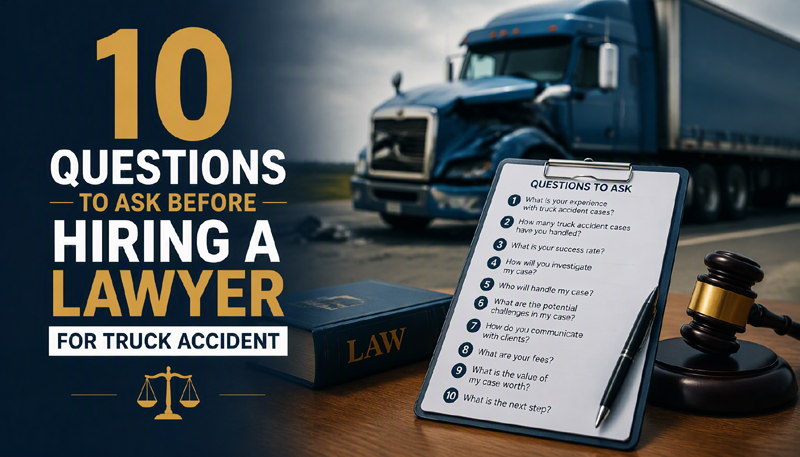
Before hiring an attorney, take the time to ask questions about their experience, investigation process, fees, communication, and approach to your case. Here are 10 important questions to ask before choosing a truck accident lawyer.
1. How Much Experience Do You Have Handling Truck Accident Cases?
The first question to ask is whether the lawyer regularly handles truck accident cases.
There is an important difference between a typical car accident and a commercial trucking collision. Trucking cases may involve federal and state regulations, commercial insurance policies, multiple potentially responsible parties, electronic records, driver qualifications, vehicle maintenance, and complicated liability issues.
Ask the attorney:
“How many truck accident cases have you handled, and how recently have you handled one?”
You can also ask whether the lawyer has represented people injured in accidents involving tractor-trailers, delivery trucks, buses, tankers, or other commercial vehicles.
Experience does not guarantee a particular result, but an attorney who regularly works on trucking cases may be more familiar with the types of evidence and legal issues that commonly arise.
A lawyer who mainly handles simple automobile accident claims may not have the same level of experience with commercial transportation cases.
2. Have You Handled Cases Similar to Mine?
Experience in truck accidents is important, but experience with cases similar to yours can be even more valuable.
Truck collisions can happen for many reasons. A driver may be distracted, fatigued, speeding, following too closely, improperly trained, or operating a vehicle that was not properly maintained. In some cases, a trucking company may be accused of negligent hiring or supervision.
Other cases may involve defective truck components, unsafe cargo loading, poor road conditions, or multiple vehicles.
Tell the lawyer the basic facts of your accident and ask:
“Have you handled a case involving similar circumstances?”
For example, if your crash involved a commercial truck changing lanes, ask whether the attorney has handled similar cases. If the accident involved alleged driver fatigue, ask whether the attorney has investigated hours-of-service and driver-record issues.
Relevant experience can help an attorney recognize what information should be requested and preserved early in the case.
3. Who May Be Responsible for My Truck Accident?
Determining who is legally responsible can be more complicated in a truck accident than in a typical two-vehicle collision.
The truck driver may be responsible, but other parties could potentially be involved depending on the facts. These might include a trucking company, vehicle owner, maintenance contractor, manufacturer, cargo-loading company, or another party.
Ask:
“Who could potentially be held responsible for my accident?”
Your attorney should explain that liability depends on the facts and applicable law.
For example, a trucking company may potentially face liability for actions of its employee in certain circumstances. A maintenance company could potentially be relevant if negligent maintenance contributed to the crash. A manufacturer could become involved if a defective component played a role.
Identifying all potentially responsible parties can be important because it may affect the available insurance coverage and the overall value of a claim.
4. How Will You Investigate the Accident?
A thorough investigation can be one of the most important parts of a truck accident case.
Ask the lawyer:
“What steps will you take to investigate my accident?”
Evidence can disappear quickly. Vehicles may be repaired, video footage may be overwritten, witnesses may become difficult to locate, and electronic information may not be preserved indefinitely.
Depending on the circumstances, relevant evidence could include photographs, accident-scene evidence, police reports, witness statements, traffic-camera footage, vehicle inspection records, maintenance records, driver logs, electronic logging information, GPS records, dispatch information, and other documentation.
In some cases, accident reconstruction professionals or other experts may be involved.
Ask whether the law firm works with investigators and experts when appropriate and whether the firm will send preservation requests or take other steps to protect important evidence.
The attorney should be able to explain how the investigation will work and what evidence may be particularly important in your case.
5. What Trucking Regulations Could Affect My Case?
Commercial trucking is subject to various federal and state regulations. Depending on the type of vehicle, driver, and operation involved, regulations may address issues such as driver qualifications, hours of service, vehicle inspections, maintenance, cargo securement, alcohol and drug testing, and recordkeeping.
Ask the lawyer:
“Which trucking regulations may be relevant to my accident?”
You do not need to know trucking regulations yourself. Your attorney’s job is to identify which rules may apply and determine whether there is evidence of a violation.
A regulatory violation does not automatically establish liability in every case, but it can be an important piece of evidence depending on the law and facts.
A lawyer familiar with trucking litigation should understand the regulatory framework that may apply to your specific accident rather than treating the case exactly like a standard passenger-vehicle collision.
6. How Will You Deal With the Trucking Company and Its Insurance Company?
Commercial trucking companies and their insurers may have substantial resources and may quickly begin investigating a serious crash.
One important question to ask is:
“Will you handle communications with the trucking company and insurance representatives for me?”
After an accident, an insurer may contact you to request information or a recorded statement. The trucking company may also have investigators or attorneys working on the case.
You should understand what communications your lawyer wants you to handle personally and what they will handle on your behalf.
Your attorney can also explain what documents you should preserve and what information you should provide.
An experienced truck accident lawyer should understand how commercial insurers evaluate claims and how early investigation can affect the outcome of a case.
7. What Compensation Could I Recover?
Truck accidents can cause significant financial and personal losses. Before hiring a lawyer, ask what types of compensation may potentially be available under the law applicable to your case.
Depending on the circumstances, damages may include medical expenses, rehabilitation costs, lost wages, reduced earning capacity, property damage, and other economic losses.
Some claims may also involve non-economic damages associated with pain, suffering, emotional distress, disfigurement, or loss of enjoyment of life.
In particularly serious cases, a person may suffer permanent disability or require long-term medical care. Understanding future losses can therefore be important when evaluating a claim.
Ask:
“How will you calculate my past and future losses?”
The attorney should explain that the potential value of a claim depends on evidence, medical documentation, applicable law, liability, insurance coverage, and other factors.
Be cautious of anyone who guarantees that your case is worth a specific amount before conducting a thorough investigation.
8. How Do You Charge for Your Services?
Legal fees are an important consideration when selecting an attorney.
Many personal injury attorneys represent clients under a contingency-fee arrangement, meaning the lawyer generally receives a percentage of the recovery rather than charging an hourly fee for standard legal work. However, arrangements vary from firm to firm.
Ask:
“What is your fee, and what other expenses might I have to pay?”
You should understand the percentage charged and whether the fee changes if the case proceeds to litigation or trial.
Also ask about case expenses, such as filing fees, expert witnesses, accident reconstruction, medical records, investigators, court costs, and other litigation expenses.
Find out how these expenses are handled and whether they are deducted from the settlement before or after the attorney’s fee is calculated.
Everything should be clearly explained in your written representation agreement.
Do not hesitate to ask the lawyer to explain any part of the fee agreement that you do not understand.
9. Are You Prepared to Take My Case to Trial?
Many injury claims settle before trial, but not every dispute can be resolved through negotiation.
Ask:
“If the insurance company does not make a fair offer, are you prepared to take my case to court?”
Trial experience can matter because a lawyer’s ability to litigate may affect negotiations with the opposing side.
You can also ask how many truck accident cases the attorney has taken to trial and what types of disputes they have handled.
A lawyer should be able to explain the advantages and disadvantages of going to trial. Litigation can take longer and involve additional costs and uncertainty, but sometimes a fair resolution cannot be achieved without filing a lawsuit.
A good attorney should evaluate the evidence and recommend a strategy based on your particular circumstances rather than automatically pushing for either settlement or trial.
10. What Is the Deadline for Filing My Claim?
One of the most important questions involves the deadline for taking legal action.
Each state has statutes of limitations that establish deadlines for filing certain lawsuits. The applicable deadline may depend on the type of claim, the parties involved, and other facts.
Ask:
“What legal deadlines apply to my case?”
This issue can become more complicated when a government entity is involved, when the case includes multiple claims, or when there are special circumstances affecting the claim.
You should not assume that you have unlimited time to investigate or pursue your case.
Your lawyer should review the accident date and other relevant facts and explain the deadlines that apply.
Because missing a legal deadline can have serious consequences, contacting an attorney promptly after a major truck accident is generally advisable.
What Should You Bring to Your First Meeting?
Being organized can help your lawyer understand the accident more quickly.
Bring the police or crash report if you have it, insurance information, medical records and bills, photographs, correspondence from insurance companies, information about lost income, and photographs of your vehicle and injuries.
Also write down what you remember about the collision while the details are still relatively fresh. Include the approximate time and location, road conditions, traffic conditions, direction of travel, and what you remember immediately before and after the crash.
You do not need to have every document before consulting an attorney. The lawyer can tell you what additional materials may be needed.
Why Immediate Investigation Matters
Truck accident cases can involve evidence that needs to be preserved quickly.
Commercial vehicles can contain electronic systems and records that may help establish what happened. Other evidence, such as surveillance footage and physical accident-scene evidence, may also be temporary.
The trucking company and its insurer may begin their own investigation shortly after the collision. This makes timely legal advice particularly important in serious cases.
Your attorney should consider what evidence needs to be preserved and whether other parties need to be formally notified about the potential claim.
Watch for Red Flags When Choosing a Lawyer
As you compare lawyers, consider more than their advertising.
Be cautious if an attorney guarantees a particular settlement, refuses to explain fees, avoids answering questions about their experience, or pressures you to sign immediately.
You should also be concerned if the lawyer appears unfamiliar with the basic issues involved in commercial trucking cases.
A good attorney should be willing to discuss the strengths and weaknesses of your claim honestly. No lawyer can guarantee a specific outcome, because legal cases depend on evidence, applicable law, negotiations, and circumstances that can change throughout the process.
Communication is another important factor. Ask how often you can expect updates and who will answer questions during the case.
Final Thoughts
A truck accident can involve serious injuries, complicated insurance issues, multiple potentially responsible parties, and extensive evidence. Hiring a lawyer with relevant experience can help you understand your rights and navigate the legal process.
Before making your decision, ask about the attorney’s truck accident experience, similar cases, investigation methods, understanding of trucking regulations, approach to insurance companies, potential compensation, fees, trial experience, and applicable deadlines.
The right attorney should be knowledgeable about commercial trucking claims, communicate clearly, explain your options honestly, and develop a strategy based on the facts of your case.
Do not choose a lawyer solely because of a promised settlement amount or a flashy advertisement. Focus on experience, transparency, communication, and whether the lawyer has the resources to thoroughly investigate your claim.
Truck accident laws and filing deadlines differ by state, and the facts of every collision are unique. This article provides general information and is not a substitute for legal advice from a qualified attorney licensed in the state where your claim arises.